
Google Deepmind: AI can now predict the weather – that’s snow joke!

Artificial intelligence (AI) is now transforming weather forecasting – offering unprecedented accuracy and efficiency for the first time, thanks to Google Deepmind! Traditional methods can rely on complex physical models and extensive computational resources, often requiring hours and hours to generate forecasts. In contrast, AI models can process vast datasets much more rapidly, delivering precise predictions in a fraction of the time.

Enter – Google DeepMind’s GenCast, an AI-based tool said to outperform leading forecasting models, including the European Centre for Medium-Range Weather Forecasts’ ENS model. Google says GenCast adapts to Earth’s spherical geometry and generates precise probability distributions of future weather scenarios. Trained on decades of data, the tech excels in forecasting extreme conditions like heatwaves and cyclones, providing accurate predictions up to 15 days in advance!

Forecasting Ahead

Similarly, DeepMind’s GraphCast predicts weather conditions up to 10 days ahead more accurately and faster than traditional systems, it has been found. It processes data in less than a minute on a single desktop computer – that is a significant improvement over conventional methods that take hours on supercomputers.

Beyond Tech Giants

The integration of AI in weather forecasting is not limited to tech giants with organizations such as the European Centre for Medium-Range Weather Forecasts (ECMWF) exploring machine learning techniques to enhance Earth system modeling, aiming to improve the incorporation of satellite observations and overall forecast accuracy.

AI’s ability to analyze extensive historical weather data helps it identify patterns and predict events that traditional models might miss.

But…

However, challenges remain, particularly with forecasting rare and extreme weather events. Experts suggest combining AI tools with traditional forecasting models could yield the most accurate predictions.

AI could therefore be ushering in a new era of weather forecasting, characterized by enhanced precision and speed.

As technologies continue to evolve, they hold promise of more reliable forecasts, aiding in better preparation for weather-related events and mitigating their impacts.

The AI Superhero blog is back! Sign up to the newsletter (on the right side) for regular AI news and developments!!


Zuckerberg Leads the Charge to AGI…

The race to achieve AGI – Artifical General Intelligence (AI cleverer than any human intelligence) – is now well an truly on with Mark Zuckerberg getting in the mix…

The race to achieve AGI – Artifical General Intelligence (AI cleverer than any human intelligence) – is now well an truly on with Zuckerberg getting in the mix…

Meta CEO Mark Zuckerberg has gone on Instagram to talk about how he is bringing two of his big AI teams closer together to work on attempts to super charge efforts to creage Artificial General Intelligence (AGI).

AGI would finally lift AI efforts well and truly above human intelligence levels – some view this as an exciting advancement of technology in the 21st century whereas there are fears machines may eventually outsmart humans altogether and overthrow their entire existence.

Anyway… here is Zuck with his plan!

Mark Zuckerberg on Instagram

In summary, he said:

  • Meta’s long term vision is to build general intelligence, open source it responsibly, and make it widely available so everyone can benefit.
  • They will bring two major AI research efforts (FAIR and GenAI) closer together to support this.
  • They are currently training the next-gen model Llama 3, and building massive compute infrastructure to support a future roadmap, including 350k H100s by the end of this year — and overall almost 600k H100s equivalents of compute if you include other GPUs.
  • Seeing progress building new AI-centric computing devices like Ray Ban Meta smart glasses.

Fascinating stuff – let’s see how this plays out and what others do to respond.

Be sure to subscribe to this blog for more AI insight going forward! The info is on the right-hand side…

Image: Mark Zuckerberg (Source: Wikipedia)

Does ‘3-second voice’ cloning by AI scare you?

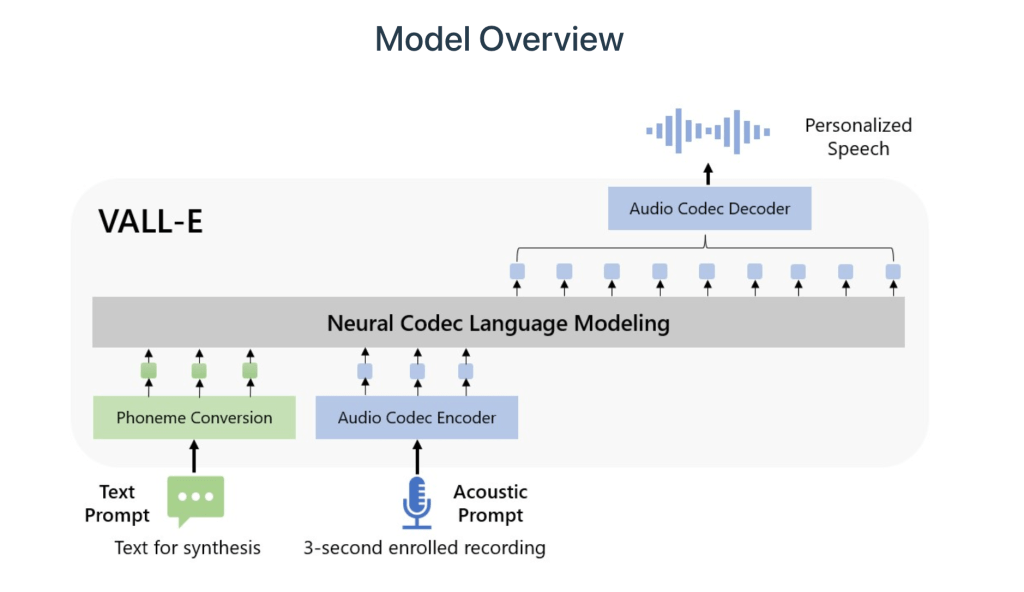
Microsoft’s VALL-E claims to clone anyone’s voice using three seconds of a clip – there are fears that such technology could lead to fraud, phishing and a spread of disinformation.

Every time we use our voice we are making something unique to us. Our unique tone and inflection can be used to identify us to others, but it is not easy. Well, that was until Microsoft came along! The tech giant has developed an AI tool called VALL-E, which can get its hands on a three-second audio clip and clone your voice in less than a minute. Click the link here to see the demo.

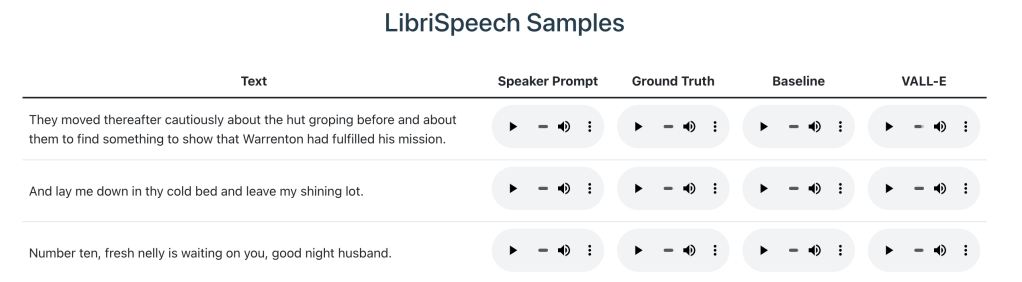
The new AI tool uses a voice recording of just three seconds and converts it into speech. Microsoft said 60,000 hours of speech trained its its new AI tool, that can mimic someone’s voice, including its tone and charisma, very easily. The software uses machine learning to process the data from the initial recording and then creates a realistic copy using text-to-speech technology. It is not too dissimilar to other software out there, including Descript and WellSaidLabs, but it only requires three seconds of inputted audio data! Examples of what can be produced are below:

The implications of the tool are vast. It could be used to create a voiceover of any video, which would be useful for those with visual impairments. It may also help people who have lost their voices due to illness or injury and need an alternative way of communicating. The software would also be useful in law enforcement and intelligence gathering, where it could be used to mimic someone’s voice and make them appear to say something that they did not actually say. This could be used for phishing, spreading misinformation or fraud. Call centres and customer service chat bots could use the tool.

For now, Researchers are working on making the AI tool more lifelike. This will involve improving the quality of its audio output and making it less robotic-sounding.

This is just one of many recent breakthroughs in the world of AI. Researchers have also managed to create AI bots that can spot fake news stories on social media, and a computer program has been developed which can detect cancerous moles.

The code is not yet available to the public but sound files and a basic demo can be accessed.

Let us know what you think in the comments below…